

'Blink' - The Power of Thinking Without Thinking
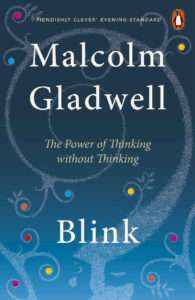
Written by Malcolm Gladwell
Blink has three aims:
“to demonstrate that decisions made very quickly can be every bit as good as decisions made cautiously and deliberately; to help decide when we should and shouldn’t trust our instincts; and to show that snap judgments and first impressions can be educated and controlled.”
When studying some years ago for a business degree, the lecturer spoke of a book in relation to first impressions. Which as we all know, we can all jump to conclusions on a very brief experience of something and conjure our opinion. The quote ‘never judge a book by it’s cover’ came about for a reason!
We studied an article about Malcolm Gladwell and his book ‘Blink’ published in 2005. Briefly the book is how the human unconscious interprets events/situations bringing in how past experiences can lead people to make informed decisions in the blink of an eye, so to speak. Main subject of this book is ‘thin slicing’. This term means the ability to use a small amount of information from a very short period of experience to come to a conclusion.
The lecture that day has clearly stayed on my mind as when I saw online a quote the other day by Malcolm Gladwell the name instantly rang a bell. I googled the name and found the book came up instantly. I decided I wanted to read it so downloaded on my Kindle, ‘Blink: The Power of Thinking Without Thinking’, intriguing!
‘Thin slicing’. The ability to use a small amount of information from a very short period of experience to come to a conclusion.
Gladwell does use examples of research by recognised psychologists like John Gottman. An example within the book uses Gottman’s research on the likelihood of divorce in married couples. Whereby research showed using a type of points system for different feelings within the partnership, with actually very accurate predictive outcomes.
Another interesting example of research discussed in the book, was that of seeing a living room belonging to somebody for 15 minutes and making a decision on that person’s character traits. It turned out that the total strangers in the experiment were more accurate in their interpretation than relatives and friends of the individual!
Gladwell's quotes I find very appropriate for our surreal situation now. Including the header image I share below quotes that resonated


A little summary about Malcolm Gladwell:
- Born in Fareham, Hampshire, England, moving to Ontario, Canada when Malcolm’s was 6 years old.
- Mother, Joyce Gladwell, was a psychotherapist and his father, Graham Gladwell, was a mathematics professor.
- Gladwell has said that his mother is his role model as a writer.
- His father allowed him to wander around the offices at his university, where Malcolm found his interest in reading and libraries.
- In 1982, Gladwell interned with the ‘National Journalism Center’ in Washington DC graduating with a Bachelor’s degree in History in 1984.
- Gladwell said of himself, “college was not an intellectually fruitful time for me”, so he decided to pursue advertising as a career. He was rejected by every advertising agency he applied to, then finally accepted a journalism position at The American Spectator
- Gladwell moved on to ‘The New Yorker’ in 1996 where his motivation lay was wanting to focus his assignments on current academic research for insights, theories, direction, or inspiration”.
- Gladwell gained popularity with two New Yorker articles, both written in 1996: “The Tipping Point” and “The Coolhunt”. These two pieces would become the basis for Gladwell’s first book, The Tipping Point,
- With release of his Talking to Strangers in 2019, Gladwell has now had six books published.
- The process behind his writing he states is: “I have two parallel things I’m interested in. One is, I’m interested in collecting interesting stories, and the other is I’m interested in collecting interesting research. What I’m looking for is cases where they overlap”.
- The six books released are ‘Tipping Point, ‘Blink’, ‘Outliers’, ‘What the dog saw: and other adventures’, ‘David and Goliath’ and ‘Talking to Strangers’.